Leaving the Lab Behind: What Happens When Experienced Chemists Trade Corporate Stability for Green-Tech Startups
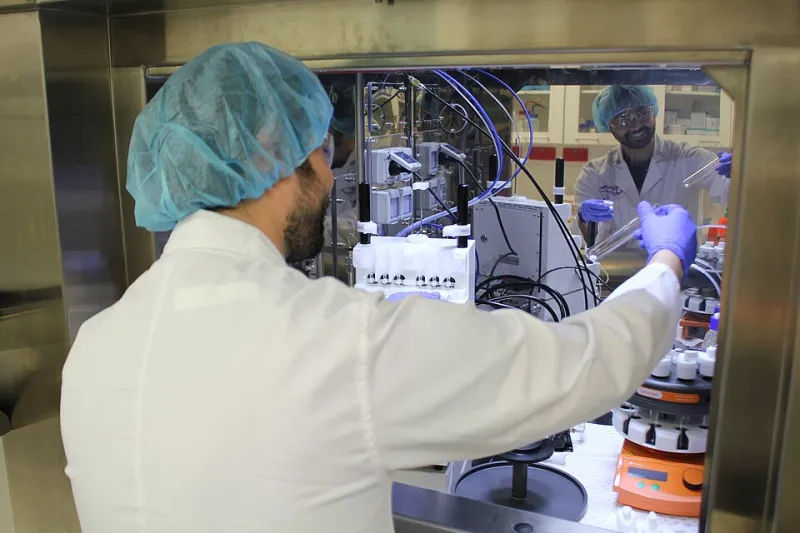
Photo: Talzir, CC BY-SA 4.0, via Wikimedia Commons
There is a particular kind of professional restlessness that has been building for years among mid-career chemists and environmental scientists embedded in large chemical corporations. It is not quite dissatisfaction in the conventional sense—many of these individuals are well-compensated, professionally respected, and operating within institutions that provide resources most academic researchers can only imagine. The restlessness is more specific than that. It is the feeling of working on problems that feel solved, within organizations that have optimized for incremental improvement, at a moment when the broader field appears to be on the verge of something genuinely transformative.
That restlessness is now producing a visible career migration. Experienced chemists—many with ten, fifteen, or twenty years of applied industrial chemistry behind them—are leaving established corporations for early-stage green technology companies at a rate that has begun to attract serious attention from workforce analysts, corporate HR departments, and the startup ecosystem itself.
What the Startups Are Offering
The incentive structure driving this shift is not difficult to understand, even if its consequences are complex. Early-stage green-tech ventures offer a combination of inducements that large corporations structurally cannot match. Equity stakes represent the most obvious draw: a senior chemist joining a Series A-funded startup focused on, say, electrolytic hydrogen production or biodegradable polymer synthesis may accept a salary reduction in exchange for an ownership position that carries meaningful upside if the company succeeds. For scientists who have spent years generating intellectual property that enriched employers while they collected fixed compensation, the equity model has considerable appeal.
Beyond financial incentives, mission alignment has emerged as a powerful motivating factor—arguably more powerful than compensation analysis alone would predict. Many of the chemists making this transition describe a desire to work on problems with direct environmental relevance: carbon sequestration chemistry, green solvent development, catalytic processes that reduce industrial waste streams. These are not abstract ambitions. They reflect a generation of scientists who entered the profession with environmental commitments and who, after years in corporate settings oriented primarily toward production efficiency and regulatory compliance, are seeking work that more directly expresses those values.
Autonomy completes the picture. In a startup environment, a principal scientist may have direct influence over research direction, experimental design, and the pace of development in ways that are structurally impossible in a large corporation where research priorities are set by business unit leaders, approved through multi-layer governance processes, and constrained by IP protection protocols. The ability to move quickly, iterate openly, and publish findings—something many corporate scientists effectively cannot do—is itself a significant draw for researchers whose professional identities are built around scientific contribution.
The Brain Drain Question
The startup pipeline is generating genuine innovation. Green-tech ventures staffed by experienced corporate chemists are, by most assessments, more technically sophisticated and operationally credible than their predecessors from the first wave of cleantech investment in the mid-2000s. The combination of startup agility with deep applied chemistry expertise is producing advances in areas ranging from next-generation battery materials to low-toxicity industrial process chemistry that well-resourced corporate R&D departments have been slower to pursue.
But the question of what is being left behind deserves equal scrutiny. The scientists departing corporate labs are not, in most cases, junior researchers still developing their skills. They are, frequently, the individuals who carry the deepest institutional knowledge about legacy processes, historical contamination events, and the environmental liabilities that established chemical companies have accumulated over decades of operation. When those scientists leave, that knowledge does not automatically transfer to their replacements—and in some cases, it effectively disappears from the organization.
This matters in ways that extend well beyond internal corporate efficiency. Legacy chemical facilities across the United States are responsible for managing contaminated sites, monitoring long-term environmental conditions, and maintaining compliance programs that require sophisticated technical judgment. The departure of experienced scientists from these environments creates a knowledge vacuum that can compromise the quality of environmental management at precisely the facilities that pose the greatest long-term contamination risk.
Some environmental professionals who have observed this dynamic closely describe a troubling asymmetry: the green-tech sector is attracting talent that could accelerate the development of cleaner processes for the future, while the facilities most responsible for the environmental legacy of the past are losing the expertise needed to manage that legacy responsibly.
What Corporate Institutions Are Getting Wrong
It would be tempting to frame this migration purely as a market correction—talented scientists flowing toward the highest-value opportunities, as economic theory would predict. But there is evidence that corporate institutions are contributing to the outflow through avoidable failures of culture and structure.
Many large chemical corporations have been slow to recognize that the scientists most likely to leave are also the ones most capable of driving internal innovation. Research cultures that reward compliance over creativity, that bury promising green chemistry initiatives in regulatory review processes, or that systematically underinvest in the kind of exploratory research that attracts scientifically ambitious professionals are, in effect, curating their own talent losses. The scientists who leave are often the ones who tried, for years, to change things from the inside.
Some corporations are beginning to respond. Internal venture structures, innovation incubators, and hybrid employment arrangements that allow scientists to work on startup-adjacent projects while maintaining corporate affiliation are all being explored as retention mechanisms. Whether these efforts will prove sufficient to reverse a structural shift—or merely slow it at the margins—remains an open question.
The View From the Conference Floor
Professional gatherings in the environmental and chemical sciences have become one of the places where this transition is most visible. Conversations between researchers from corporate laboratories and their counterparts who have recently made the move to green-tech ventures reveal a community in genuine flux—one where career paths that once followed predictable institutional trajectories are now branching in directions that neither corporations nor startups have fully prepared for.
For the broader field, this disruption carries both risk and opportunity. The risk is a fragmentation of expertise that leaves legacy environmental challenges undermanaged while new green technologies are developed without the institutional memory to anticipate their own long-term consequences. The opportunity is a reorientation of the profession's most experienced talent toward problems that genuinely demand solutions—if the knowledge transfer mechanisms, mentorship structures, and professional networks can be built to carry that expertise where it is most needed.
The chemists leaving are not abandoning the field. They are, in many cases, betting on it. The question is whether the institutions they leave behind—and the communities those institutions affect—can absorb the transition without losing more than they gain.